

breaking the career script
on risk, reinvention, and the case for treating your career like a series of experiments

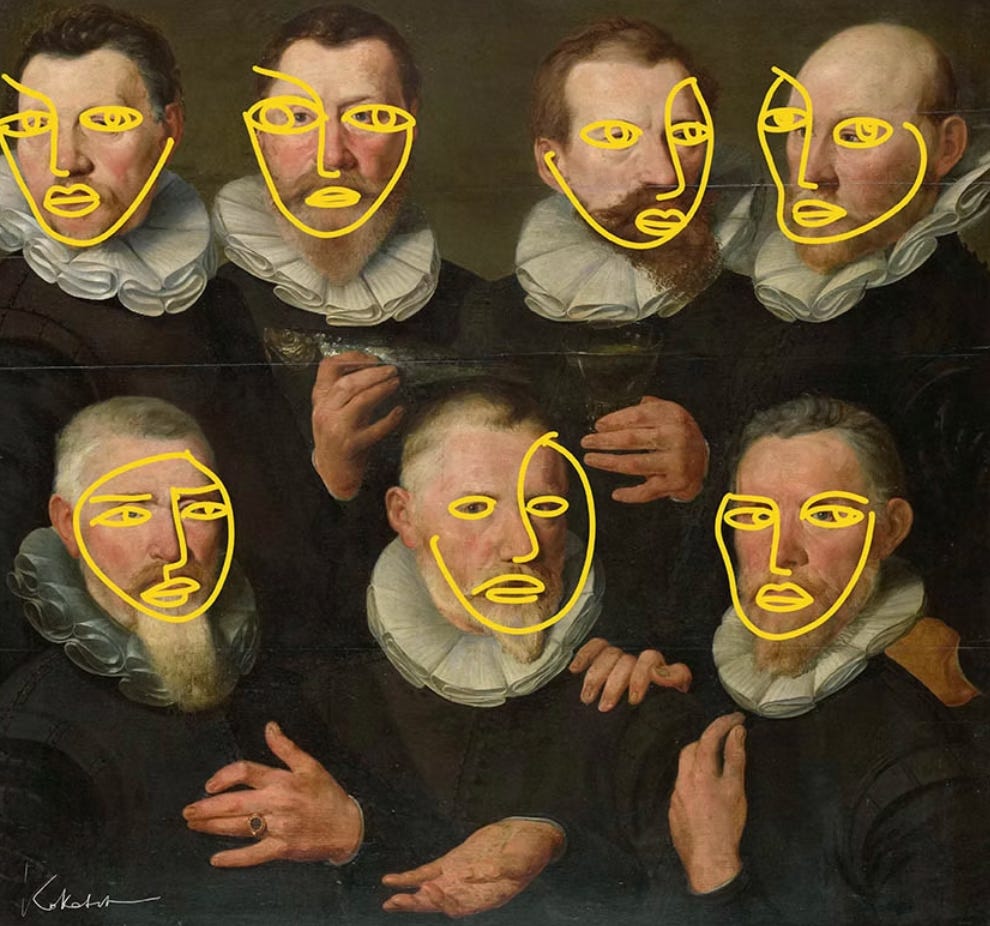
I still remember the look on my mom’s face when I told her I was quitting my first job—one of bewilderment masked by an attempt at support. Her overall affect was a kind of bland, frozen stare.
I was twenty-seven, and I’d been working at the same company since college. By any traditional measure, it was a dream job. My coworkers were smart yet humble. My manager was great—a funny and nice guy who had my best interests at heart. The place offered a healthy work/life balance and the kind of financial comfort that made life feel easy. And I was even able to check off one of my bucket list goals: I worked in London for a year.
It wasn’t just good in the present; the future was promising too. The company bred a sense of loyalty. They never fired anyone, and they compensated people generously. Stay there another decade, and I’d be making mid- to high-six figures, like everyone else who’d never left.
I’m giving all this context so you can understand my mom’s reaction when I told her I wanted to leave. She’d worked hard as a single parent. For her, job stability, a good income, and a healthy work environment were the pinnacle of success. What else could I want?
The thing was, even I didn’t know. I just knew that job wasn’t it. It felt like dating a great guy, one you know is husband material, but you’re just not ready to commit. I knew I had it good, but I couldn’t help it. There was just a deep itch for more, even though I couldn’t quite articulate what that something more was.
I didn’t know it when I made the decision to leave, but I was taking the first step of walking away from the traditional career path.
After I quit, I took a year off to travel before getting an MBA and a consulting job. Despite a hefty $200K investment in business school, it was at best a lateral move. That was okay, though, since I thought it would get me closer to what I wanted—a project-based role that would keep the work feeling fresh and my mind feeling stimulated.
That lasted for a few years before I tried another lateral move, this time to a tech startup. It was fun at first—more great coworkers—but I didn’t buy into the vision, and working at a startup will give you the sort of deluded confidence that makes you think: “Why not just do it on my own?” And so I did.
I quit my job and explored a few solo business ventures, like opening a coffee shop or a Swedish sauna. But instead, I ended up writing a book, then starting this Substack.
At first, I thought of this pivot into writing as a midlife recalibration, splitting my career into two distinct phases—the corporate first half, the creative second half. Lately, I’ve started to see it differently. Those job changes weren’t incremental. They were resets. Each time I was trying something new, running a little experiment. Each time getting closer to what I wanted.
I wasn’t building toward one specific thing or following a set path. I was taking lots of different shots on goal.
the traditional career
The traditional career path is the one we’re probably all most familiar with: start in an entry level role and work your way up over the years into some peak position. You might begin as a marketing analyst and, with enough grit, commitment, and networking, eventually become a VP, maybe CMO if you’re lucky. Even if you switch companies over the course of your career, progression usually trends up and to the right, either toward a better title or a higher salary—hopefully both.
If we go with a finance metaphor here, this type of career path generates value through compound interest. The more you stay, the more it all adds up, like when a conventional investor purchases stocks and holds them long-term. In a traditional career, the return isn’t linear. Consistent, daily efforts lead to exponential growth in experience, title, pay, and network over time.
the portfolio career
Another career path that’s gaining a lot of traction is the portfolio career. Instead of steadily climbing a corporate ladder, you allocate time and energy across multiple streams of related work. Think of a creator who writes a newsletter, sells courses, and does brand partnerships.
Compound interest isn’t the main driver for portfolio careers. It’s less about staying in one lane for decades and more about actively shifting your time into whatever streams yield the highest return. It’s closer to how a private equity investor operates. In PE, debt amplifies the upside of an investment. In a portfolio career, that leverage comes from skills, audiences, and assets that carry across everything you do. One skill—writing, cooking, design—can power several income streams. One audience can support multiple products. One idea can be repurposed across platforms. Leverage and capital allocation build a system that multiplies itself.
the experimental career
And then there’s the path that doesn’t get talked about as much. It’s the one I found myself on without realizing it. You try something for a few years, then make a change. Sometimes, you move into a related field, like I did with my early career changes. Other times, you go in an entirely new direction. The through-line isn’t the job itself, it’s the learning. Each move is an experiment. You gather data. You figure yourself out. You take what you learn, and you try again.
I have a friend who started her career in an operations role at a startup. A few years later, she taught at an alternative school, then managed a coffee shop. Last year, she started nursing school. Each time, she had to go through the painful process of starting over. Her progress wasn’t linear. It took pay cuts and title demotions, but now, she’s happier than ever.
From the outside, when someone is making these changes, it can look like they’re confused, maybe even avoiding commitment. But when you’re in it yourself, it feels different, like it’s an iterative process. You’re using each job as a way to map your own internal frontiers and find the boundaries of your self. You learn what you like and don’t like, and each move gets you closer to some sort of alignment. Something like a personal resonance, a place where you can approach your work with more connection, more wholeheartedness, more purpose. It’s something I’ve started to call an “experimental” career.
It’s a path that may appear haphazard from the outside, but it connects to a familiar venture capital concept: power laws. Unlike compound interest or leverage, power law returns are driven by extreme outcomes. If you’re a VC, most of your investments won’t pan out. Some even go to zero. But the ones that succeed can succeed so wildly that they make up for all the losses. There’s no ceiling on the upside. The winners drive the value of the fund, not the losers. For those on the experimental career path, the goal isn’t minimizing downside. It’s staying open to the one thing that could change everything.
Even though we’re using investment metaphors here, upside doesn’t just mean more income. It could mean a greater sense of aliveness in your work, more time to spend with family, or more of anything else you find meaningful.
None of these options—compound interest, leverage, or power laws—are better or worse. Instead, they live on a spectrum where there’s a tradeoff between risk and return. It’s less about any of these paths being right or wrong in aggregate, and more about them being right or wrong for you.
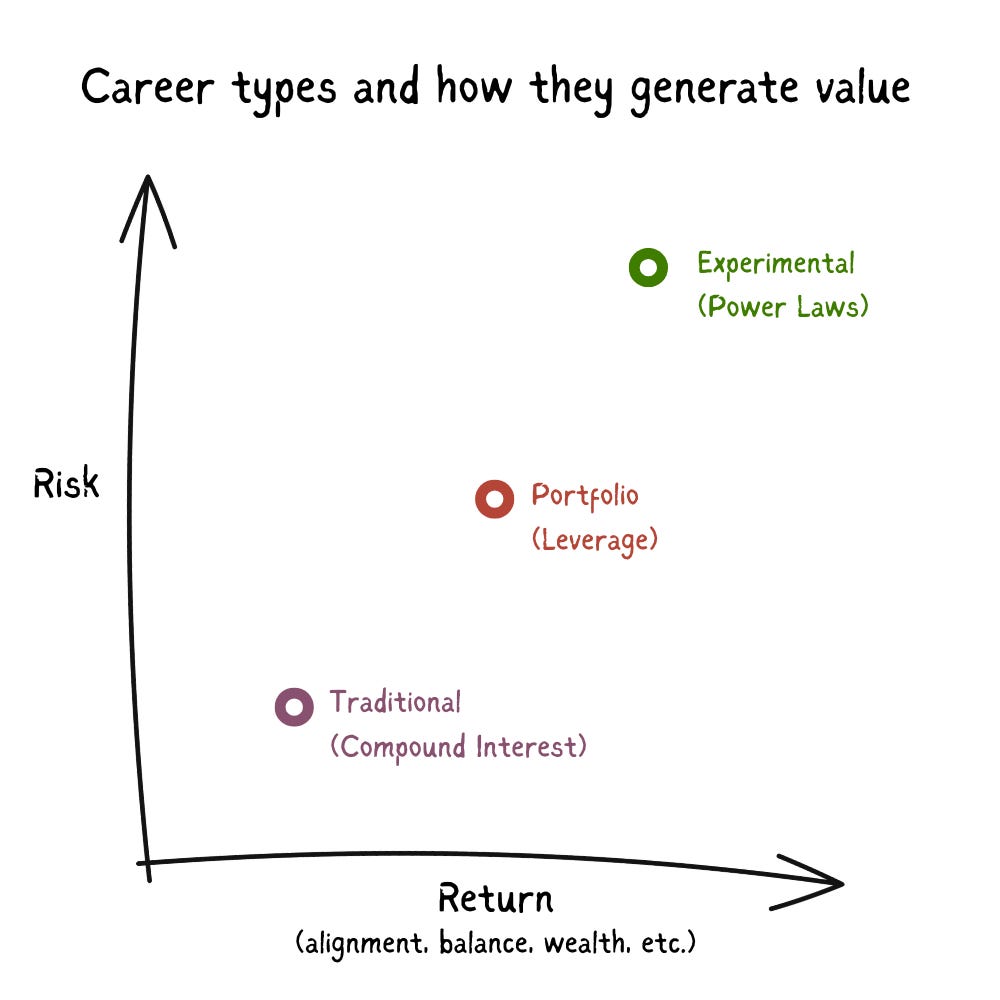
For me, an experimental career makes sense. I’m an all-or-nothing person with a low tolerance for boredom and a high tolerance for uncertainty. It’s a combination that means I’d rather dive into something new than settle for work that doesn’t light me up. I’m okay front-loading risk and taking bets, especially now, while I’m still young-ish and have minimal responsibilities—no kids, no mortgage. When I look at it that way, the power law framework feels like a natural extension of how I already operate. It explains why a more experimental path feels energizing instead of overwhelming. And even if it’s not a fit for everyone, it does come with a handful of advantages:
Bias toward experimentation: You focus less on following a prescribed path and more on running small tests that help you learn about who you are, what you want, and what you’re good at.
Less pressure: Despite being higher in overall risk, each project, role, or venture is just one shot on goal. You’ll have others. This detachment creates freedom and reduces fear because your identity isn’t tied to any single outcome.
Freedom from the sunk-cost fallacy: When you expect some degree of failure, you stop clinging to things just because you’ve already invested time and effort. Instead, you can pivot and reallocate your energy to higher potential areas.
Returns across domains: Like David Epstein says in his book Range, experience and knowledge across domains isn’t just additive, it’s multiplicative. The more experiments you run, the more valuable your future bets become.
Focus on asymmetric opportunities: Being practical and focusing on safe, linear gains isn’t really wise here. You look for big bets and you tilt your energy toward creativity, leverage, and scale.
Even with these benefits, the experimental career path isn’t always practical or accessible for everyone. It requires a high degree of capital and freedom. As I moved between jobs, I was lucky enough to have savings from each previous one to fund the next. And with my latest pivot to writing, I’ve had to move back home to save money. Even so, it’s been hard to make it work. There is no blueprint for this.
Looking back now, my mom’s face when I broke the news I was quitting my first job makes sense. I wasn’t making a “bad” decision, but I was choosing a path she’d never been able to imagine. That path hasn’t been smooth or predictable, but each shot I’ve taken has brought me closer to something that actually fits me. My wins haven’t come in the form of more money or prestige. Instead, I’ve found room for alignment, curiosity, and building a life that actually feels like mine. In a world where AI seems to be dissolving the old career rules, maybe the best strategy is just to play your own game.
And keep taking shots on goal.

Paul Millerd writes about following the pathless path and how to choose the “way of unfoldment” over the the “way of achievement”
If you treat your career like a series of experiments, you have something like 12 shots in life to make things happen
How to start from scratch, and the “exist, insist, persist” framework I keep thinking about

This newsletter is where I make sense of the world—philosophy, technology, esoteric rabbit holes, and the future we’re headed toward.
Everything here is free. If you want to support my work, you can subscribe or grab a copy of my novel Dark Days Ahead.
Keep in touch—drop a comment below or follow me on Instagram @ndocherty.



Really insightful article, thanks for putting it out there.
This wildly and deeply resonated, and is the stuff I’m exploring in my (new) essays and the content that excites me most. Would love to connect. It’s so reassuring to find other similar voices out here.